Giant Steps
Jack Whitten: The Messenger at MoMA, March 23 - August 2, 2025

Studio log, 23 December, 1992
To avoid at all costs:
1) Formalism
2) Slickness
3) Corporate image
4) Literal
5) Narrative
6) Male-female category
7) Abstract expressionism
8) Excessive use of color
9) Christian iconography
10) Black bourgeois aesthetic
11) Other artist
12) Abstraction as design
13) Naturalism
14) Post-modernism
15) Appropriation
16) Decorative
17) Illustration
18) Art History
19) Self pity
20) Excess emotional baggage
This is an excerpt from one of the many handwritten studio notes included throughout the Jack Whitten exhibition at MoMA, organized by Michelle Kuo. The memo shows a process of negation and self-criticism, a reminder of possible pitfalls, and an instruction to stay on course. The show begins with two pieces from around the time he jotted these reminders, one painting dedicated to Miles Davis, and another to Art Blakey. They demonstrate the style Whitten is best known for, or that I know him for, which used fragments of acrylic paint, laid down in trays to dry. He would break the paint up into small square chips and set them into canvas. From a distance, they have an appearance of monochromatic heatmaps of clouds, or astrological formations. The grid is visible, not as drawn lines, but in the gaps between each tile. He has referred to paintings like this as a “cosmic net,” and the surface is rewarding to look at from any distance, in the way the tiles do and don’t overlap, and the presence of intersecting textures that are held together by the overall structure. In these works, Whitten achieved something entirely original, both in how the works are made, and their overall appearance. He successfully veers around the twenty traps he was trying to avoid.
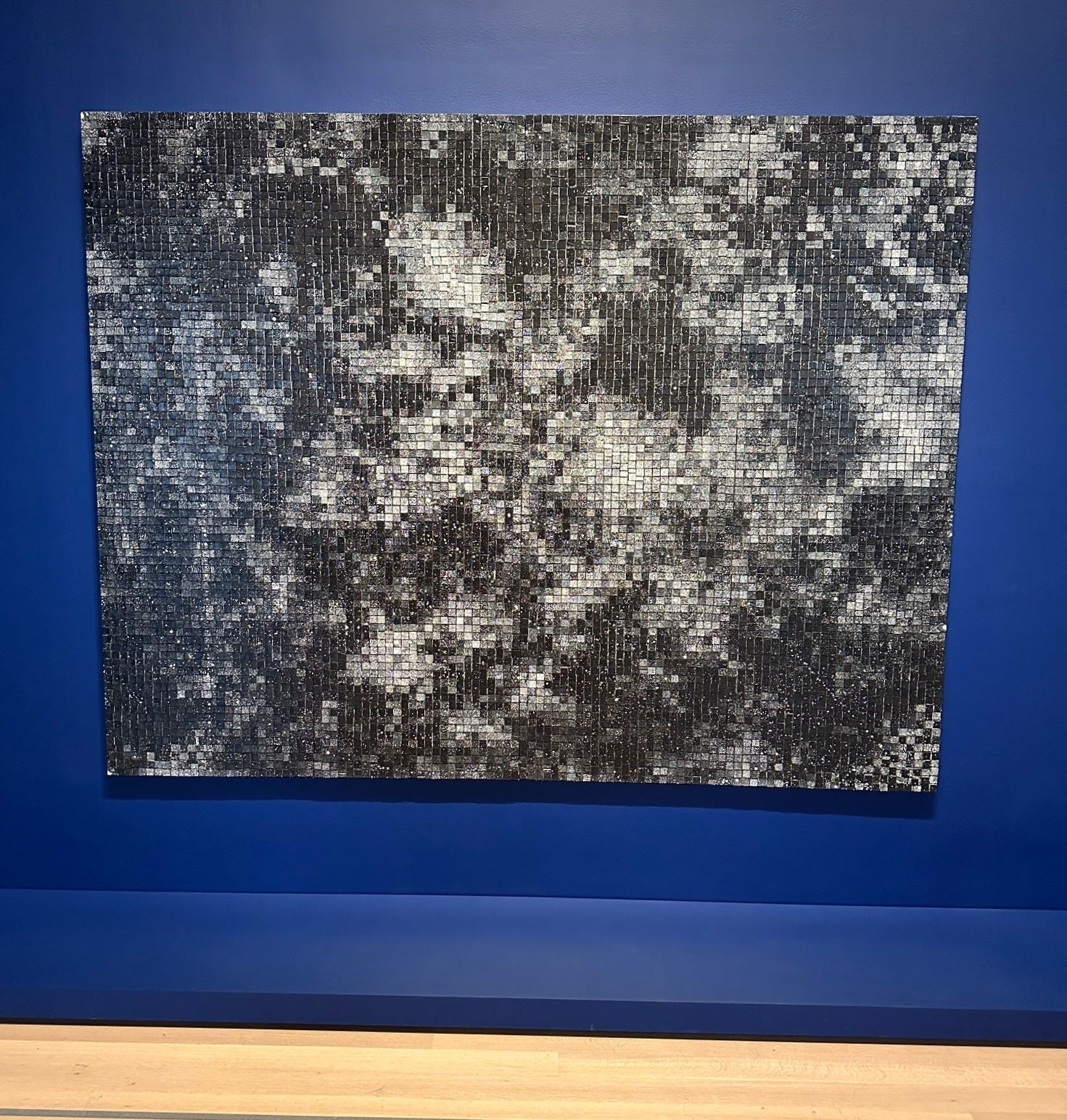
To be honest, I didn’t know they were done in paint. I always assumed it was glass or ceramic pieces that he was affixing to the canvas. The exhibition characterizes Whitten as a restless experimenter. He was a Black artist firmly committed to abstraction during a time where figuration was considered the more revolutionary style of painting, or at least the more straightforward way to make a picture with visible political commitments.
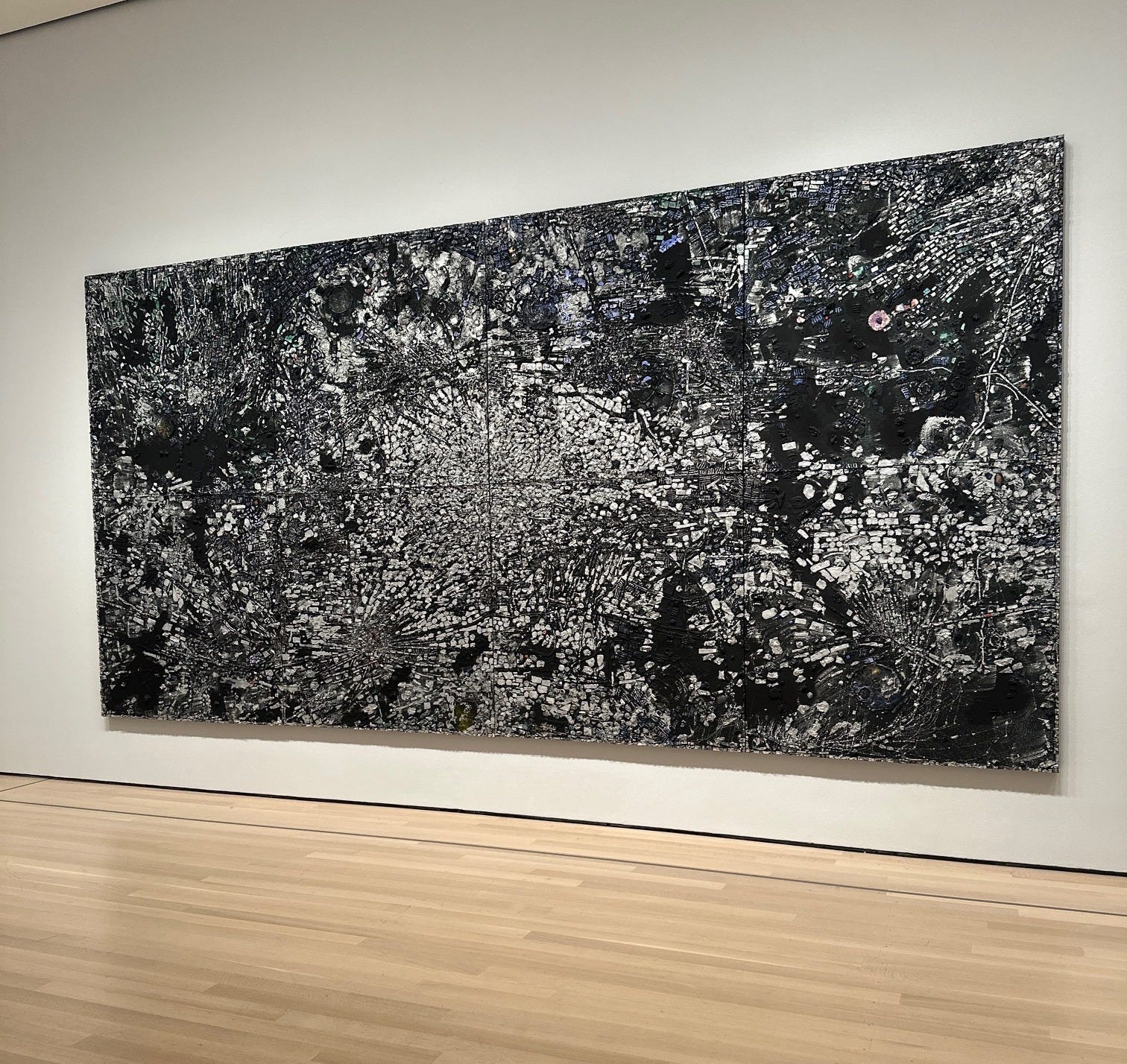
Throughout his life, Whitten dedicated works after people, often other visual artists, musicians, or political figures. Despite going through notable distinct stylistic periods, Whitten maintained the convention of dedicating his works through their titles throughout his career. Some of the earliest examples are in the King’s Garden series of the late 60’s, a group of watery abstractions with faint landscape connotations, dedicated to Martin Luther King Jr. This practice spanned to the last years of his life and to monumental scale in a work like Atopolis: For Édouard Glissant (2014), named after the Martiniquais philosopher and poet. It’s rarely apparent who a work is an homage to based on the surface of the painting. In Atopolis, the sprawling constellation might have something to say about Glissant’s ideas—maybe in relationality, in its lack of a main focal point, or the absence of hierarchical lines—but the way he engaged with his inspirations was murkier and more conceptual than just resemblance. I don’t think that’s a problem. As it’s presented in the exhibition, Whitten’s main concern seemed to be coming up with new ways of making, which entails new ways of thinking, which in turn might model new ways of being.
Whitten rose after a generation of Black figure painters like Romare Bearden and Jacob Lawrence, both of which he dedicated paintings to. He was taught by a fellow abstractionist, Norman Lewis, who he also titled a painting after. In his studio notes, he seems cautious to avoid emulating other artists or getting too close to them. He names his influences frequently, but he is careful not to imitate them. On a page of his studio log from 1988, he wrote that he had changed a word in the title of one of his paintings from “Arc” to “Spiral” after realizing Ellsworth Kelly frequently used the term “Arc”: “I am too arrogant to share space with anyone.” Though funny, this reads as tongue in cheek given that the full title of the painting he’s talking about is literally Spiral: For R. Bearden.
There is figuration, albeit suppressed figuration, in some of Whitten’s works from the 1960s. It quickly disappears and is replaced by branching arms of inquiry on material and process. One thing I appreciate about the exhibition is its willingness to explain distinct, individual steps of how he made things. The curators understand that his experiments with technique mark some of his most significant contributions to art history, and the choice to foreground technique in the explanatory text shows a trust that the museumgoing audience will understand this importance. The way he builds his surfaces and how changes in technique changed the appearance of his artwork is picked up and carried across the six decades of works represented in the retrospective.
Throughout the show I asked myself, is this work spatial? Or rather, in what sense is this work spatial? There are ways where his early style, especially the work of the 1960s, feels of its time in its appearance. The pastel color palettes, the custom formats that fix certain aspects of the composition (like the use or circular or triangular canvas supports), and the disappearance of the human hand (see the Light Sheet series, where he lowered color onto the canvas with fine mesh frames, creating a mark without gesture) run in line with trends in high modernism. Choices like these situate Whitten as someone who was thinking attentively about what other artists are doing and trying to digest it through his work. For the most part though, and this is increasingly the case as he progressed as an artist, the idea of the picture plane feels mostly unimportant to the success or failure of a given artwork. Surface is important, but often what matters is the actual surface, not an image that it suggests or projects. It is more about the dense paint material on the canvas than it is about an evocation of painterly space.
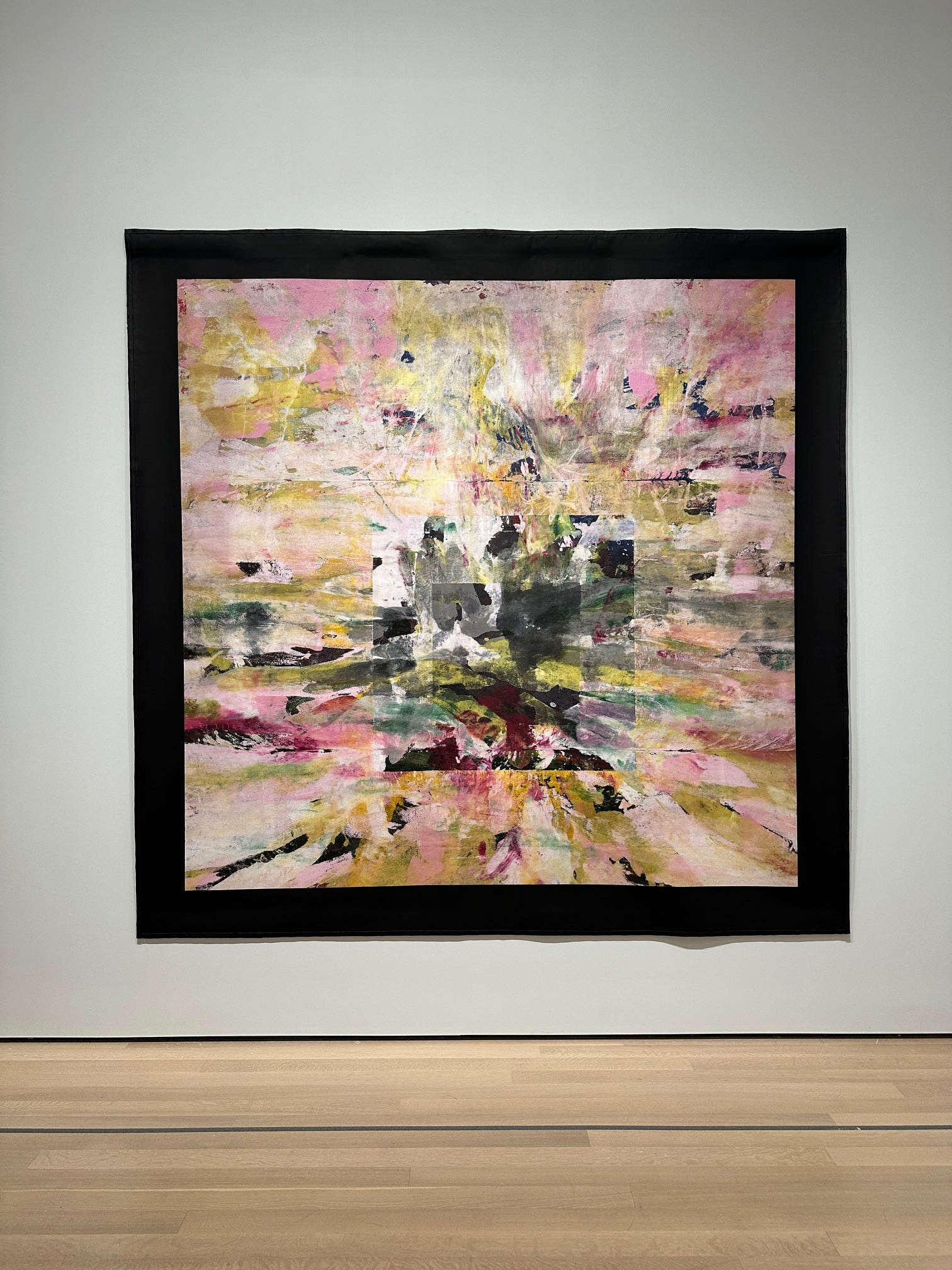
In his writing, Whitten speaks of volumetric surface as in the space taken up by the actual paint, the way its ridges protrude into literal space. In October 1972, he wrote: “Space is important: that much is true. I still come back to surface. Please I am trying hard not to be confused. This shit is complicated! To be as clear as possible without getting confused. I just want a slab of paint.” I think the idea of a slab as it relates to surface gets to something important in his art. “Slab” implies opacity, or at least physicality. It is an accumulation of matter, a sequence of strategically layered accretions. In Whitten’s work, it is frequently developed or disrupted by a kind of finalizing act, like a swipe or a sweep. In that sense, space is rarely tied to the convention of perspective, or illusionistic space. This is not painting as a view through a window, it’s a view of a wall. An artist like Mark Bradford seems like a worthy successor to Whitten’s use of density.
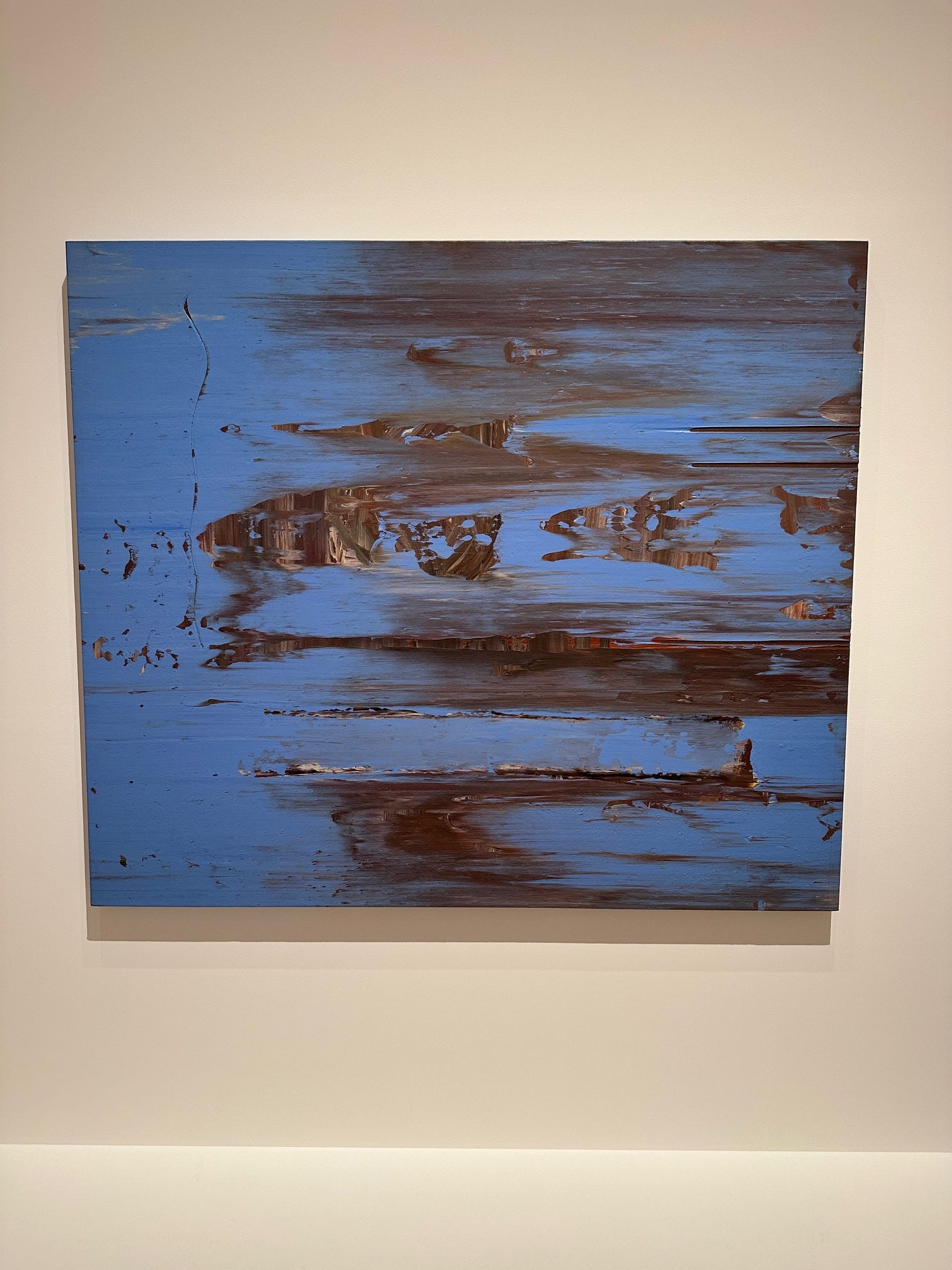
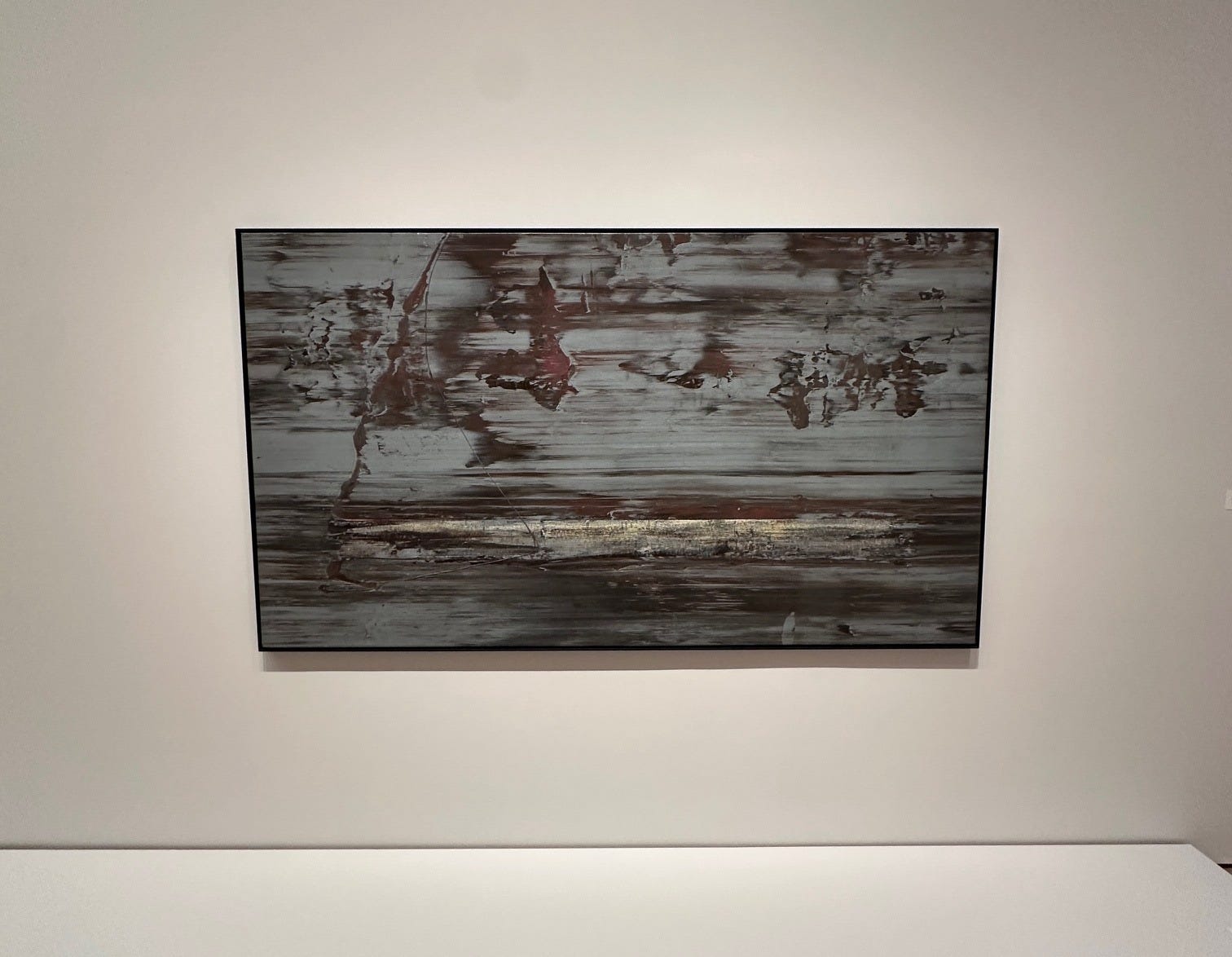
One of Whitten’s many inventions towards the problem of surface was his creation and use of the “developer” tool, a large wooden rake-like object that could be fitted with additional components like combs or blades to create texture. The smudgey paintings of the late 60s and 70s anticipate Richter’s squeegee paintings by over a decade—Richter began making paintings with a similar technique in 1986.
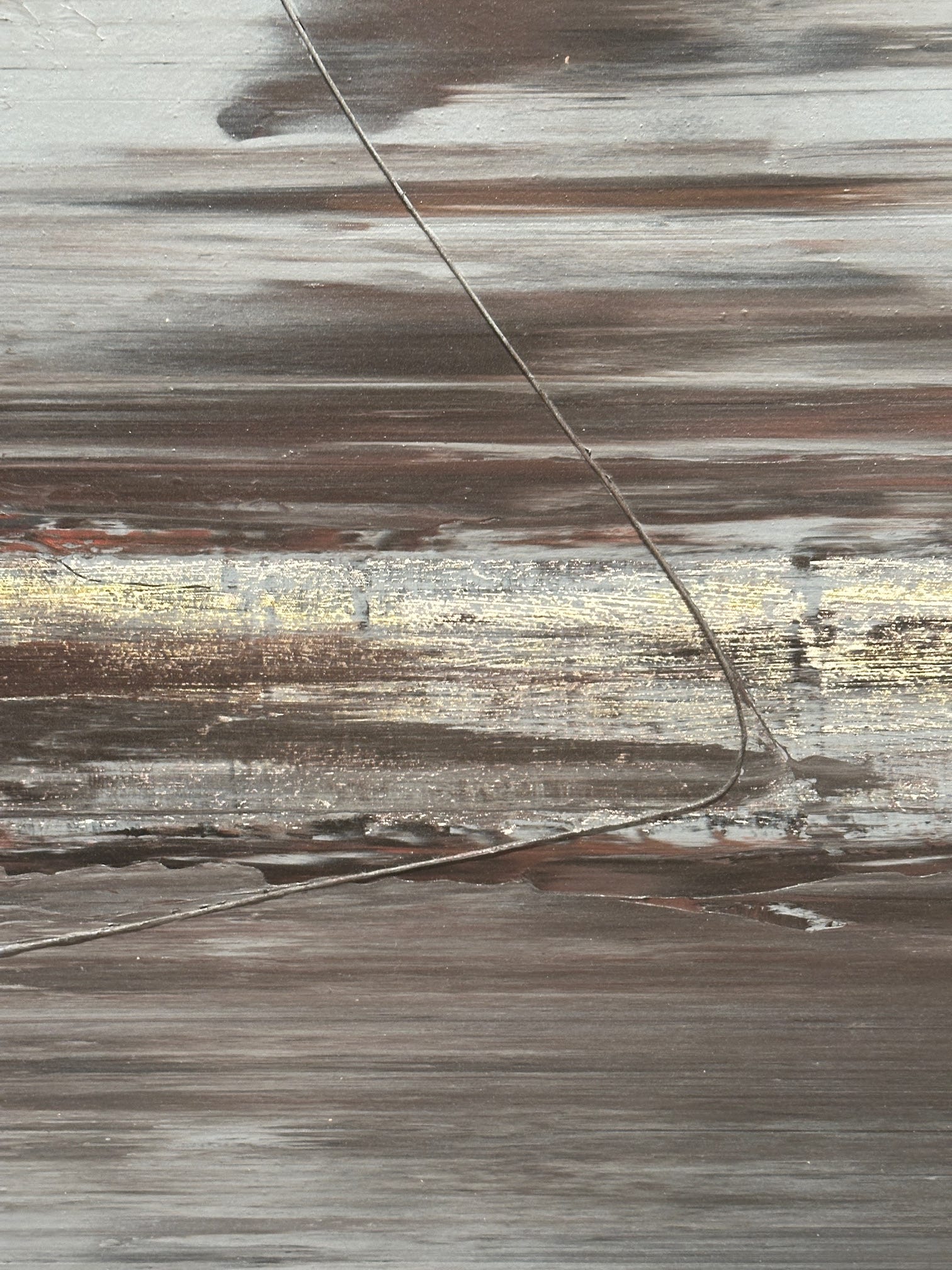
Whitten wanted surfaces that were smeared unpredictably, and he often referred to them as photographic. I take this to mean they related to photography in the way they are finished quickly after the setting is prepared, and in the involvement of chance. The pulling motion of the developer is analogous to the click of the shutter in the way it quickly and permanently fixes a set of temporary conditions. He used combinations of different pigments so that some dry before others to produce different textures. He set pieces of rope in wet paint to complicate the sweeping motion. He used tools like afro picks and saws to incise lines in the acrylic before its dried, building striations into the finished image. In these works, there are hints of the layers of built up paint underneath the final surface, but it lands like a crack in a colorful wall that reveals another wall behind, there is always a solidity.
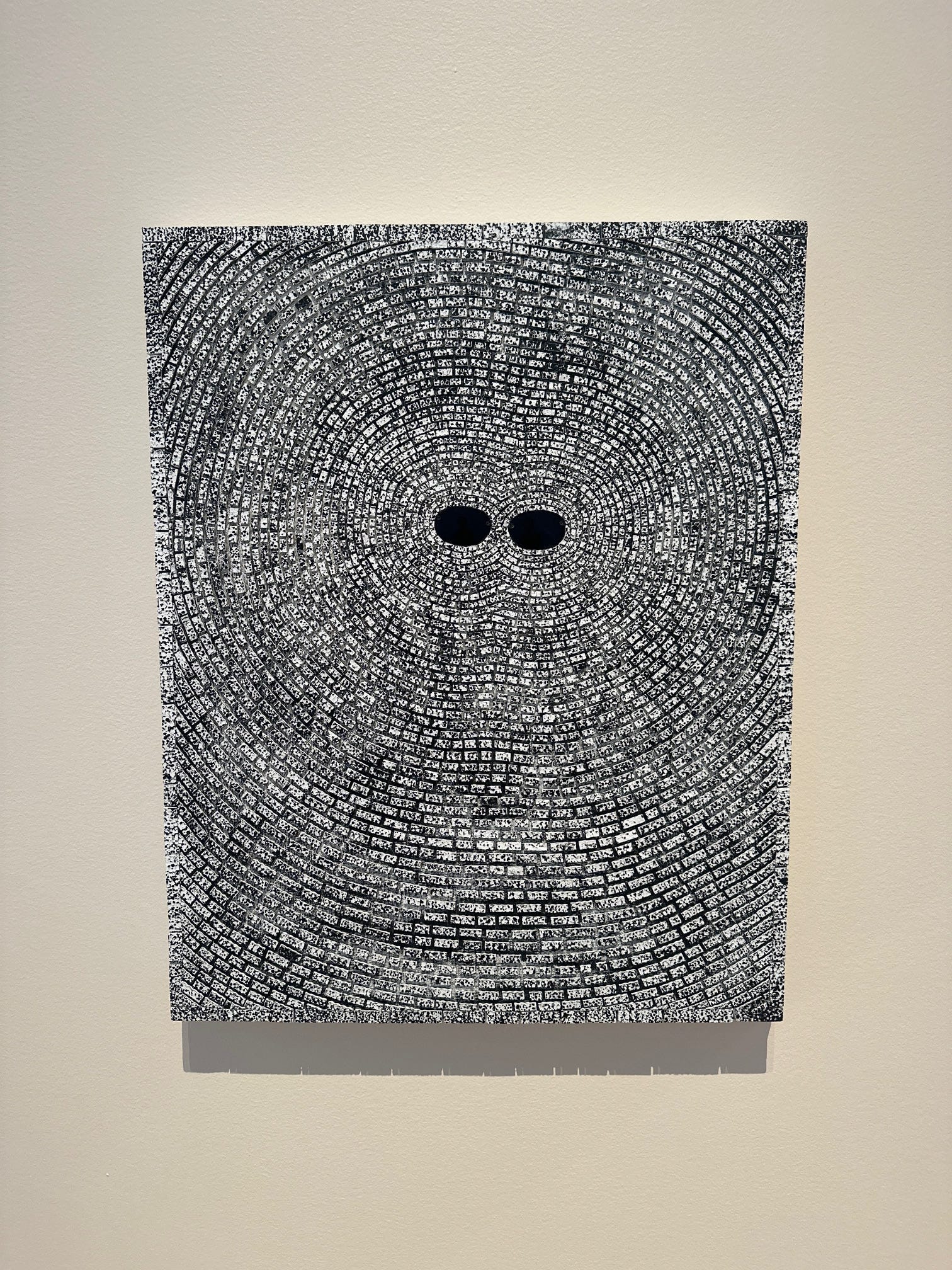
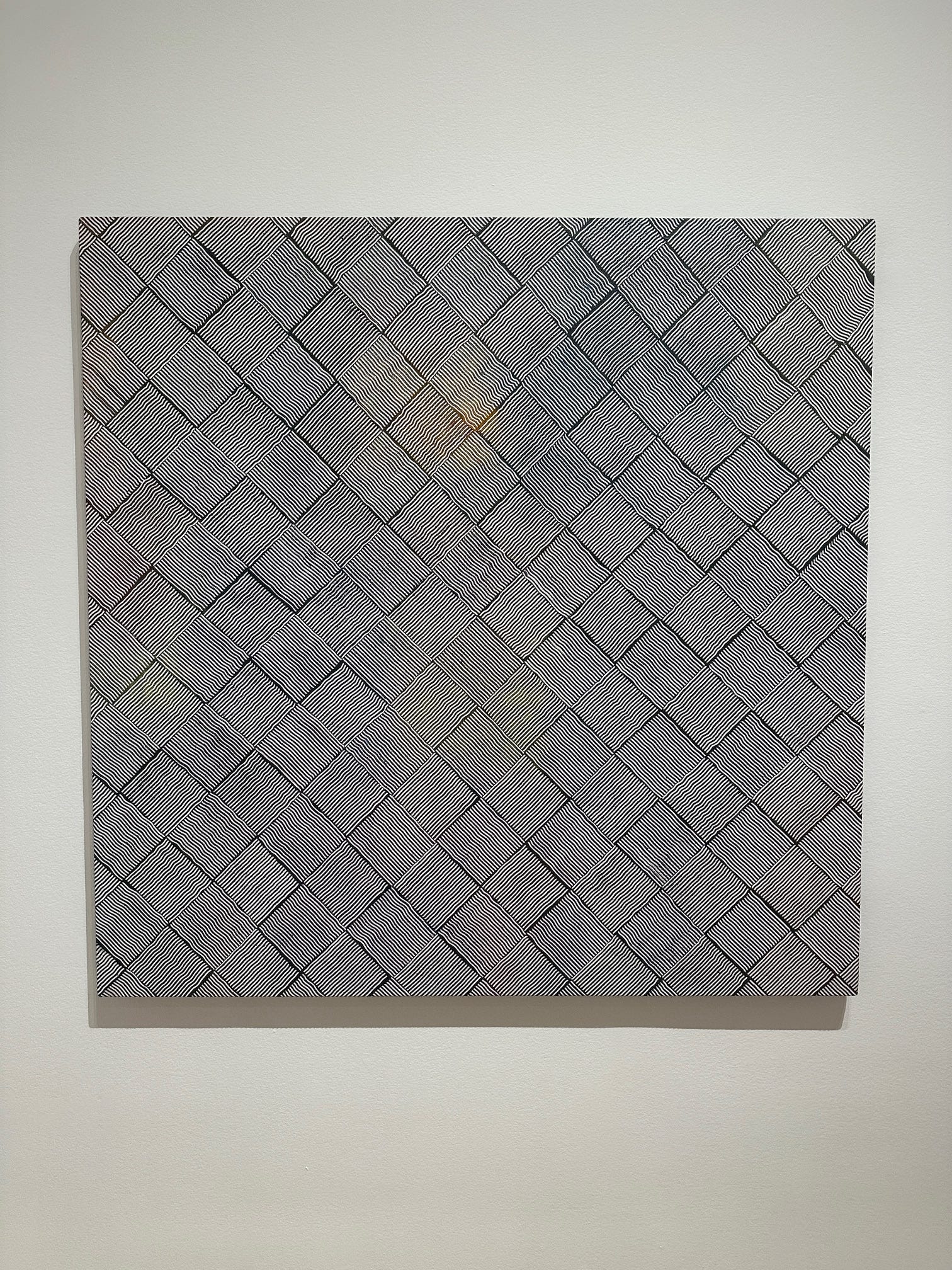
In the paintings of the late 1970s, his experimentation approached the edge of optical illusion. The color and lines seem to vibrate in how the color is buried underneath gridded lines. There is a relief-like quality to all his works. The exhibition is careful to show the emergence of the grid as a guiding structure. To generalize, it shows his trajectory going from fields of incised lines to a grid, to everyday objects interrupting the grid, to casts of objects being embedded in a grid. The endpoint of this inquiry is the later tiled paintings, which became his focal point from the 1990s and onward, where the relationship between the paint and the lines that contain it is reversed. Instead of allowing the paint to be structured by a matrix of horizontal and vertical lines, the placement of distinct tiles of paint become what structures the grid—that matrix is now formed by the negative space between pieces of paint, how close or far apart they are from each other when he put them on the canvas.
It was consistently important for Whitten to combine structure and chance or improvisation. While it has become cliché to compare abstraction to jazz, here it is coherent and relevant. Whitten’s brother was a jazz musician, he hung out with jazz musicians, and he thought of his work explicitly in terms of jazz. Another line from the 1988 studio log, October 14: “Jazz is my metaphor.” We see how he takes innovations in jazz music, like Coltrane’s conceptualization of sound as a wave, and applies them to a visual medium. Some of the most exciting works in the exhibition are low-stakes studies on paper, or works with additional restrictions, like the powerful Greek letter paintings, rendered mostly in monochrome. A downside of that unfettered openness to chance and possibility is that the collage of elements and ideas can occasionally become too expansive and lose focus and power. The works that put this looseness in tension with some sort of stricter organizing principle are more successful.
The mosaics don’t all work—I hate to say it but I don’t know if the monument to 9/11 with ash and glitter totally works—but when they do, the effect is incredible. The paint chips are glassy but still have all the detail of paint, some are textured, some galactic, often painted on top of after being arranged. Material layers keep recurring. There is a propulsion to keep twisting on an idea, to take part of it, and change it, and rinse and repeat. He was trying to set up and solve his own inquiries. He was careful to establish his own objectives, to be in touch with the moment, and with the past, while not getting lost in consensus ideas of what artists should do. The show at MoMA is beautiful and comprehensive. Like any good solo show, it gives a full picture of his personality, concerns, and how he made those concerns manifest in the finished works.